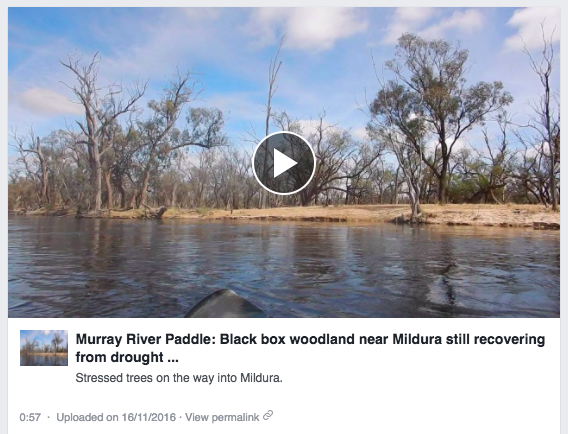
Mildura to Wentworth
Anna joins me - Long meanders - Dunes - Cowanna Bend - Royal Hotel
Today was the first day paddling with my daughter Anna. She has decided to join me for the 320 km stretch from Mildura to Renmark. Many say this is the quietest stretch of the river - at least from Wentworth down. It begins with the ancient rolling sand hills of the mallee, alternating with river flats and ends in the tall limestone cliffs of the Murray Gorge region.
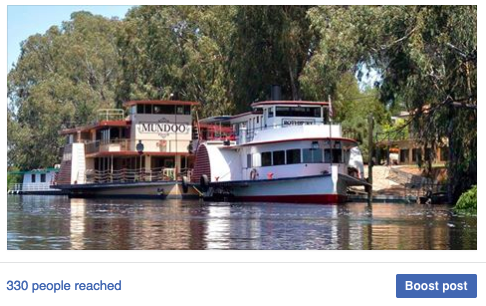
The day began with a short chat with the captain of the PS Rothbury, who brought us up to speed on navigating the Mildura Weir. “It is easy”, he said, “there isn’t one - it’s been removed”. Mildura is the only weir on the river still on rails. Torrumbarry Weir used to be like this too, until a new type was built with gates that can be raised in the 1990’s. When the river rises weirs like Mildura can be pulled out of the river and replaced once it falls again. So there was no weir drop to worry about and with the level being the same on either side of where the weir used to be, there was no need to use the lock. As we passed the downstream side of the lock, we saw a team of workmen motoring slowly through the weir garden. No doubt they were inspecting infrastructure, but it just looked like they were having a good time and didn’t want to rush to get back to the office. It was the last boat we were to see for the day. There was no-one on the water for the next 50 km.
The biggest change between today’s river and that of the days before was the bends. Six to ten km long bends became the norm. Around Echuca, where I come from, if the river does not take a corner within a kilometre, we call that a long straight and there are legends about the winds that can blow along them and the battles we’ve had against them. Here we would be laughed at. The river runs in its ancient bed. No meanders within the meanders. This is the ancient river. How old must these banks be?
Around 15 kilometres downstream of Mildura we came across Mildara winery. Mildara is set at the top of a high sandstone cliff. The kind of formations built when the inland seas of 30 million years ago dried up and the sandy sediments were blown into big rolling dunes. Real mallee and gold once you put water onto it. The winery had built a solid set of steps from the top of the dune down to the foreshore where a barbecue was available for staff and visitors on the river bank. The effort put into making the steps was typical of the approach the Mildura community has put into making the river accessible to all. There are roads, picnic places, fences and a walking track which ran for at least 20 kilometres. The river charts we use suggest that this part of a whole Murray River walking trail. What a great thing that would be.
After 26 km we came across Cowanna Bend. This place was special. Cut off by an ever more permanent river cutting, it is virtually an island and by the looks of things, one on which there is no livestock. The diversity and richness of the understory was greater than any place I’ve seen on the Murray so far. I have been used to seeing black box woodlands with either saltbush, or grass, not the intricately patterned wilderness I was seeing here. The trees seemed healthy and wild, tangles of branches and thick canopies of leaves. Beyond the face of the forest, it appeared mythical and untamed. We drifted past this semi-flooded landscape, watching soaking in. On the NSW side were the communities of Coomealla, Dareton and Tucker’s creek. Houses set on high ground, or built on man-made islands of soil - the contrast could not have been greater. There was even a golf course around which people scooted in electric cars. Were they aware of the treasure across the river from them?
To get to Wentworth from Victoria you have to drive over two bridges. One at Abbotsford over the Murray and another over the Darling at Wentworth itself. Abbotsford Bridge is a single lane span lift bridge, designed to let the paddle steamers through. There were gates with stop signs either side of the span, which stopped the traffic when the span was about to be lifted. Wentworth Bridge uses hydraulics to lift its central span. No other bridge on the Murray has the same mechanism. Being between two major rivers, Wentworth is prone to floods. In 1956 when flood waters came down both the Darling and the Murray the town was only saved by the efforts of its farmers and the little grey ferguson tractors. The huge levee they built still surrounds the town, protecting it from future floods. The caravan park we are staying in is outside of that levee. Its vans and cabins are gradually being moved onto higher ground to avoid the rising river.
In the park, and later in the Royal Hotel we got to know two couples who were travelling around Australia. Both had spent the last three days kayaking on the rivers and exploring the streams and billabongs in the area. They too had explored amongst the flooded gums, seen kangaroos hopping to high ground, marvelled at the ancient trees and enjoyed the birdlife as their kayaks glid quietly through the trees.
I think Anna particularly enjoyed this aspect of the day. She photographed many birds, even a nesting tawny frogmouth. How she saw it I do not know. For me, having company was novel and refreshing. That company being my own daughter was special.
The day began with a short chat with the captain of the PS Rothbury, who brought us up to speed on navigating the Mildura Weir. “It is easy”, he said, “there isn’t one - it’s been removed”. Mildura is the only weir on the river still on rails. Torrumbarry Weir used to be like this too, until a new type was built with gates that can be raised in the 1990’s. When the river rises weirs like Mildura can be pulled out of the river and replaced once it falls again. So there was no weir drop to worry about and with the level being the same on either side of where the weir used to be, there was no need to use the lock. As we passed the downstream side of the lock, we saw a team of workmen motoring slowly through the weir garden. No doubt they were inspecting infrastructure, but it just looked like they were having a good time and didn’t want to rush to get back to the office. It was the last boat we were to see for the day. There was no-one on the water for the next 50 km.
The biggest change between today’s river and that of the days before was the bends. Six to ten km long bends became the norm. Around Echuca, where I come from, if the river does not take a corner within a kilometre, we call that a long straight and there are legends about the winds that can blow along them and the battles we’ve had against them. Here we would be laughed at. The river runs in its ancient bed. No meanders within the meanders. This is the ancient river. How old must these banks be?
Around 15 kilometres downstream of Mildura we came across Mildara winery. Mildara is set at the top of a high sandstone cliff. The kind of formations built when the inland seas of 30 million years ago dried up and the sandy sediments were blown into big rolling dunes. Real mallee and gold once you put water onto it. The winery had built a solid set of steps from the top of the dune down to the foreshore where a barbecue was available for staff and visitors on the river bank. The effort put into making the steps was typical of the approach the Mildura community has put into making the river accessible to all. There are roads, picnic places, fences and a walking track which ran for at least 20 kilometres. The river charts we use suggest that this part of a whole Murray River walking trail. What a great thing that would be.
After 26 km we came across Cowanna Bend. This place was special. Cut off by an ever more permanent river cutting, it is virtually an island and by the looks of things, one on which there is no livestock. The diversity and richness of the understory was greater than any place I’ve seen on the Murray so far. I have been used to seeing black box woodlands with either saltbush, or grass, not the intricately patterned wilderness I was seeing here. The trees seemed healthy and wild, tangles of branches and thick canopies of leaves. Beyond the face of the forest, it appeared mythical and untamed. We drifted past this semi-flooded landscape, watching soaking in. On the NSW side were the communities of Coomealla, Dareton and Tucker’s creek. Houses set on high ground, or built on man-made islands of soil - the contrast could not have been greater. There was even a golf course around which people scooted in electric cars. Were they aware of the treasure across the river from them?
To get to Wentworth from Victoria you have to drive over two bridges. One at Abbotsford over the Murray and another over the Darling at Wentworth itself. Abbotsford Bridge is a single lane span lift bridge, designed to let the paddle steamers through. There were gates with stop signs either side of the span, which stopped the traffic when the span was about to be lifted. Wentworth Bridge uses hydraulics to lift its central span. No other bridge on the Murray has the same mechanism. Being between two major rivers, Wentworth is prone to floods. In 1956 when flood waters came down both the Darling and the Murray the town was only saved by the efforts of its farmers and the little grey ferguson tractors. The huge levee they built still surrounds the town, protecting it from future floods. The caravan park we are staying in is outside of that levee. Its vans and cabins are gradually being moved onto higher ground to avoid the rising river.
In the park, and later in the Royal Hotel we got to know two couples who were travelling around Australia. Both had spent the last three days kayaking on the rivers and exploring the streams and billabongs in the area. They too had explored amongst the flooded gums, seen kangaroos hopping to high ground, marvelled at the ancient trees and enjoyed the birdlife as their kayaks glid quietly through the trees.
I think Anna particularly enjoyed this aspect of the day. She photographed many birds, even a nesting tawny frogmouth. How she saw it I do not know. For me, having company was novel and refreshing. That company being my own daughter was special.

Anna photographing a tawny frogmouth in an overhanging tree

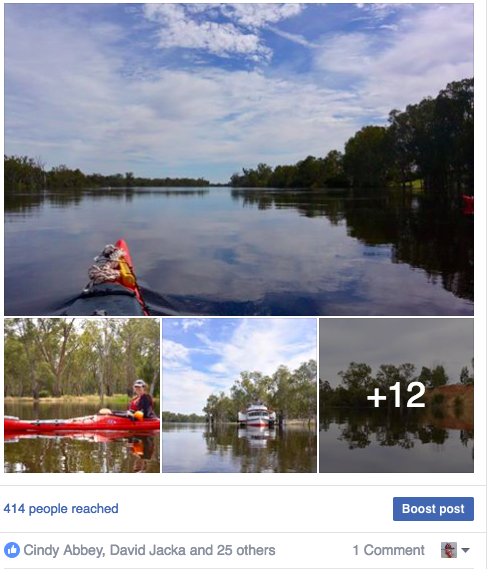
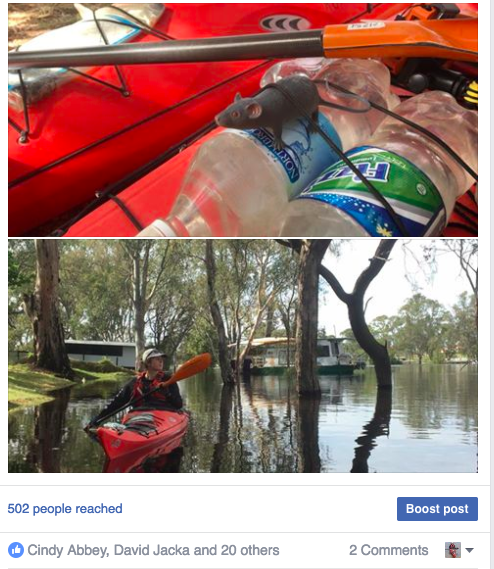
The rat is allowed to ride on the outside today, because we've got company. My daughter Anna has joined me for the 350 or so km to Renmark.