Day 37: 666 km Kulcurna Station 21st Nov 2016
Lock 8 - Memories - Being overtaken by a dead fish - Refuges - Erodion - Flies - Delvils Elbow

Lock 8 to Kulcurna Station
It had been a warm night at our campsite at Lock 8. The sun has a lot of strength this time of the year and sleeping on the ground was like lying on a hot plate. When we were kids, before we were told to be sunsmart, we used to lie on the concrete at the town pool. It was too hot to walk over, so we would splash water on it first and then enjoy the warmth from below and above at the same time. It was easy to fall asleep, but that didn’t matter. The goal was to be brown, all over, and we thought that you had to get properly sunburnt to get a good tan. However camp was no town pool and with the fast currents and amount of dead fish, not so appetising. I haven’t been for a swim so far on this trip - which is a first.
Today, we finally got ahead of the dead fish. The last couple of days have been shocking. We made macabre jokes about sticking flags in the bigger cod to see who made it the furthest in 24 hours: we had the speed, but the fish went 24/7. Being overtaken by a dead fish is not a point of honour. It seems that blackwater is worse at this end of the river and I wonder whether with each new input of organic matter from the forest, the levels in the river are accumulating. Upstream, blackwater was the result of water flowing through the forest and sitting in shallow sections long enough to soak up the organic matter - like a strong brew of tea. Patches were local and soon diluted by the main flow. Down here, where the river is wider and deeper, and where the river is only just beginning to break its banks and enter the floodplains on either side, the blackwater is clearly from upstream. Perhaps the levels of organic matter are more than the microorganisms can break down and so the effect is transported downstream. Belinda Hansen, manager of Kulcurna Station worries that here, the effect will be worse than in 2011. “Back then, it was all over in one slug, this looks like it is going to go on for months”.
Back in the Middle Murray, the cod survive by finding points of aeration behind snags, especially those with fine twigs. These aerate the water through waves and ripples. They are also know to swim up tributaries, like the Campaspe and Goulburn Rivers. I thought that no such rivers existed down here, but I was wrong. Today we passed by quite stately creeks; Carr’s Creek, Mungo Creek, Rufus River (the outflow from Lake Victoria) and Sharp Point Creek: each as wide as what we would call a river in Victoria and capable of creating their own flood events following heavy rain. There is diversity here that takes time to recognise, that takes time to understand. We tend to look for blanket solutions, when the answer is more complicated than that. “Complicated, but simple”, says Belinda Hansen. Complicated, because it takes time to understand local environments. Simple, because once you do, it makes common sense. Their key is to involve locals, especially those who have built up an understanding of their area over a lifetime, or in cases, much longer.
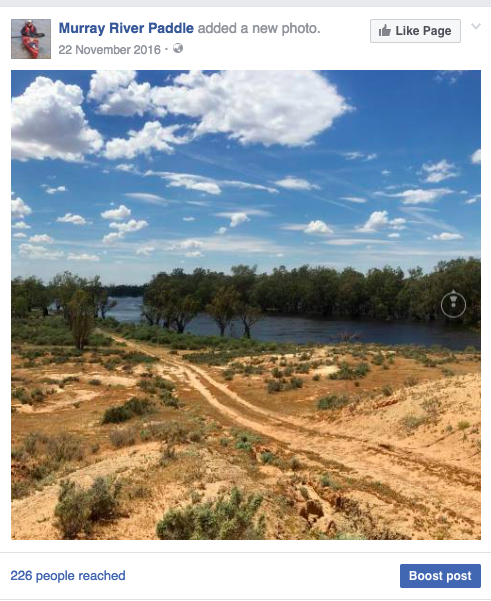
Every now and then the Murray of today, bumps up against its parent banks. The banks left when Australia was much wetter, our mountains kilometres higher and the river as wide as the great rivers created by the great rainforests and tallest mountains in the world today. It was kilometres wide and left banks that were 20 to 30 metres higher than today and bends that ran for 10 to 20 kilometres. Today’s river winds around inside this ancient river course, like a trickle. However, every now and then it bumps into one of these walls and, like a steady drip, erodes into it. When it does so, it reveals something of the past. Our lunch stop at the base of an enormous rise was an example. Erosion was rampant. Gullies had eaten into its face and had worked their way inland hundreds of metres, revealing multi-coloured, soft sediments. The ground was covered in saltbush and the kind of small round limestone pebbles that form in this area when rain dissolves the calcium in this ancient sea bed, growing crystals as it evaporates, much like lime does in kettles. It was hot and the kind of strong wind that heralds a change in weather, was blowing. We had a view over the dry land bordering this corridor of green, the ribbon of life that the river is to the areas it flows through. In the distance we were watched by red kangaroos, licking their forearms to cool down. On the old billabongs, dead trees stood sentinel, telling their story of the past.
Out on the water, there are few insects to bother you. Coming ashore they lept upon us. Too hot for mosquitoes, but not for flies. Our backs were covered in them and they were determined to find things to nibble on around our faces, including around our eyes. When Anna left the bank in a flurry of splashes and arm waves, all her flies came to me. Thanks Anna! They kept with me through the three thunderstorms that followed that afternoon. They somehow found places to hide in the heavy rain that fell. Emerging to sit on my hat, like dogs on the back of a ute. These flies wanted to travel down the river. It became part of a joke between us, especially when we came together for a break and the flies would swap people.
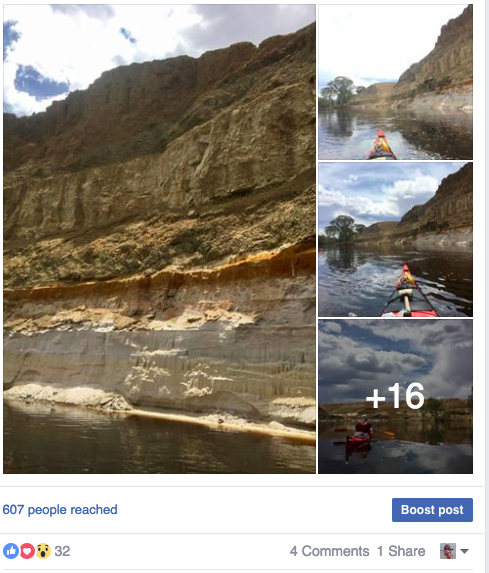
We passed four stations today. The first was Ned’s Corner, a former sheep station which is now run by Fund for Nature, as a wildlife reserve managed for endangered animals, which around here means not just limiting the number of cats and foxes, but also the number of kangaroos. University students from LaTrobe stay in dorm-like accommodation near the kind of big old shearing shed that is typical of the area, as part of their arid zone land management studies. We had planned to call in, but didn’t as we had word that the managers would be away on that day. You have to get supplies some time or other when you live in the bush. It seems that more and more stations are opening their doors to the public, providing an opportunity to see what life is like in this part of the country and sharing their love of the land they live in. Lake Victoria Station offers ‘Possum’s Riverboat Safaris’ as part of a ‘Murray Darling Holidays’. The homestead is set behind the ruined walls of the original limestone building and its owner, Paul Chors is an authority on local history. A little further downstream, Warrakoo Station, is impressively preserved and now run by the Mildura Aboriginal Cooperative. Perhaps because of its proximity to Devils Elbow, arguably the most impressive place on the river where the Murray erodes into its grandfather banks, creating a crumbling vertical face. Here there are clear layers of white sands and green clays. Books talk about the Parilla Sands and Blanchetown Clays. I wonder if these are them. Having the high river I was able to paddle right up close and look. I had to be careful though, as behind me I heard blocks break off and at the end of the cliffs was the most enormous whirlpool. Not far downstream of Devil’s Elbow is Kulcurna Station. If I was to choose one location as being quintessentially Australian on the Murray, it would be Kulcurna. Located at the edge of wetlands, nestled at the base of tall red cliffs, it looks out over red gum forest. This is my third time here. Something in my psyche, the image of what it is to be Australian is twigged here. It is a family home, with all its memories, and Belinda Hansen, our knowledgeable host, is its connection. I have written this post on the wired in veranda, over looking the river, listening to John Williamson’s ‘Galleries of Pink Galahs’. It almost seems written for this place.
After walking up to the top of cliffs to find reception to send this post we will move on. We have a short day today. We can explore, but we will need to rug up, the temperature is 20 degrees lower than yesterday with rain predicted.