Murray River Paddle 2016 Day 40 & 41 Headings Cliffs to Renmark Nov 25

Headings Cliffs to Renmark: 565 km

Blackwater - Flood frequency - Water quality - Floating logs - Renmark - Classic cars



For the last part of the day paddling from Custom’s House (South Australian Border) to Headings Cliffs and for the whole of today we did not see one dead fish. We also observed that even at the time we left our campsite, that there were no shrimp gathered at the side of the river. This means that the black water and the fish it has killed upstream have not yet reached Renmark. It is possible that the blackwater in the river has been diluted by flows from tributaries, like the Chowilla Creek and Rufus River (Lake Victoria) and that the worst of its effects will be avoided because of it. Time will tell. However, there is no avoiding the fish deaths. There are reports that bream have been seen dead around Mildura. There are many backwaters and places where the river flows over the land, rather than simply down the channel upstream of Mildura which will have caused locally intense blackwater, so the fish deaths are not surprising. That the bream are also dying is not a good sign, they are hardier than the cod. Today, the river had not yet exceeded its banks around Renmark, however with a 30cm rise still coming from Mildura, this should be expected in the coming week or two. The question is really, how far will the effect be transported downstream? It seems that no-one really knows.

Tragic as it is, the fish seem to survive, or recolonise areas lost to their species following these events. Their numbers bounced back from the 2011 events. They should following this one too. Here, the habit diversity of the river is the key. Each stream, each cutting and each snag, offers survival niches. Were the Murray simply a channel, the whole population could be lost by such an event.

We arrived early in Renmark today and did a car shuffle from Mildura, preparing for Anna’s departure tomorrow. Since there is no public transport between Renmark and Mildura anymore, I hired a car. The car was driven to the caravan park where I am staying by a fellow who is a few years older than me. He is 58 and has been in Renmark all his life. “You know”, he said, “we never used to have black water when I was younger, so what has changed?” I agreed. In my 52 years at Echuca, black water - at least on this scale, has only been a recent phenomenon. Like most locals, he could name the years that the river had flooded in his lifetime. “We had floods in 74, 75, and in the 80’s, then 92, 2011, and now, but it is only the last two floods that have created this issue. They are no higher than those earlier floods and they were around the same time of the year. The difference is flood frequency, the number of times that the river has been high enough to flow through the forest has been decreasing. Before Dartmouth Dam was built the Murray’s level changed dramatically every year, watering its banks and rebuilding its beaches. It also seemed to flood about every 5 years. when Dartmouth was built, it doubled the holding capacity of dams in the upper Murray, where 95% of the rain in the Murray Darling Catchment falls. Water which normally flooded the forests and washed away the litter was caught and kept for irrigation. Now these high rivers seem to happen only every ten. In some places, much less. Large areas of the Edwards-Wakool Forest had not flooded since 1992 (24 years ago). Because the backwater is produced locally, it is possible that some sections of the river have been skipped. That dead fish have been reported at Goolwa, but nothing in between, suggests that blackwater has formed ahead of the main flow and highlights the complexity and patchiness of these events.

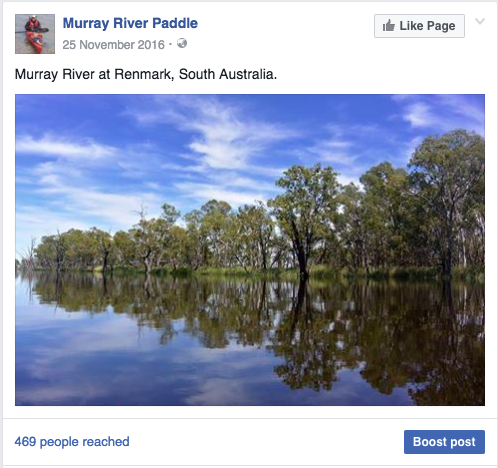
Booking into our caravan park, the ladies at reception told me that the blackwater had scared away many of their customers. “People think that we are underwater,” they said; “we’ve had lots of cancellations.” There is a lot of fear around the high river. The black water is not poisonous. It is simply dark in colour and low in oxygen. If the river was low enough to expose the beaches, I would be swimming in it - mind you, not if there were a lot of dead fish around. Though dark, the water is actually clearer than usual. I can see my paddle to a depth of around 30 cm. When boat traffic picks up at this time of the year, I can usually only see about 5cm. I filter the water to drink it using a ceramic filter designed for the muddy water holes of Africa. The filter is fine enough to take out bacteria and viruses, but not colour and taste. Most evenings I filter three to four litres of water. I drink two during the day and use two for cooking, tea and water whilst I am on land. Surprisingly, it tastes as good as usual. Most houseboat businesses have closed, citing danger from floating logs and the blackwater. This is an overreaction in my opinion. There are hardly more logs floating than in a normal year and certainly much less for houseboat hirers to avoid than when the river is full of boats, swimmers and people floating down on pool toys. The fish deaths are not pretty, but they are still novel enough, that people count them, they are not everywhere. The blackwater itself makes the river reflect the blue of the sky. Despite its unfortunate initial effect, it feeds and will kick start the whole river ecosystem. Following this event, river life will boom, because it has now been fed. Witnessing the high water is an educational and beautiful experience. Its what a river does normally, before we began disrupting its cycles. People should get to know these cycles, not avoid them.

The paddle into Renmark was a pretty one. In the morning light, the orange and yellow colours of Renmark region’s cliffs stood out against the clear blue sky. Whistling kites hunted low over the water and between trees. Darters sat on their nests - some for the second batch of chicks already. Black swans lead us away from their young. Anna found that she could imitate their call and held quite a long conversation with one of the parents. Perhaps her call was like one of the young signets.

Renmark has an impressive foreshore. As a river town, it depends on tourist numbers from Adelaide. River towns have suffered enough from the blue green algae of last summer. They don’t need to have fear of black water keep people away from a (now) rare high water event. If you haven’t witnessed it, get out and have a look. Tell your friends too. Its pretty special.

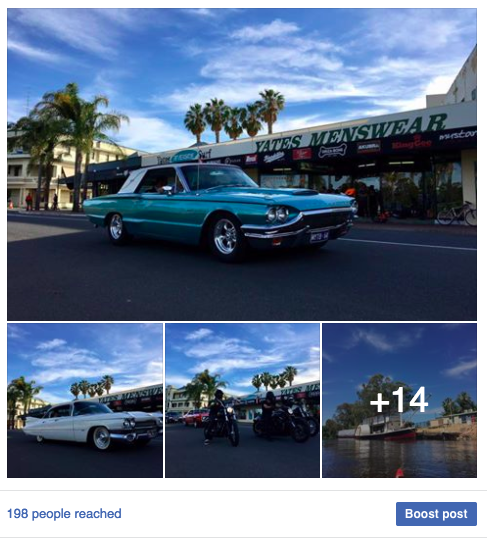
In town, an event was taking place just for the locals. Renmark High School students were celebrating the end of year with a prom. Like a debutante ball, the young couple had gone to great lengths with their preparation, but unlike the deb balls I know, the street was blocked off and couples arrived in classic cars. Locals lined the streets and cheered as each couple arrived. Each car had a number. As they approached the red carpet area an announcer described the features of the car, a little of its story and who was driving it. The driver would then step out of the car, open the doors for the young ladies and then the couples would also be introduced. There was a whole array of vehicle types, from 1950’s rockabilly style coupes, Pontiacs, Cadillacs, Mustangs, Firebirds, Holden specials from every era and Falcon 500’s. The locals voted on which made the best entrance. One young fellow, in a successful effort to impress, was in a red Bathurst Torana escorted by three Harley Davidsons. What a great way to involve, develop and celebrate community!

Visit a river town if you can. The floods are part of their story. Get out there and discover it.
Day 41: 564 km Renmark - Rest Day 25th Nov 2016


Murray River Paddle 2016 Day 39 Customs House - Headings Cliffs (near Renmark)

Day 39: 595 km Heading Rd. Renmark

Rain - Life in a tent - Natural splendour - River rising - Chowilla Woolshed - Kangaroos


It rained much of the night. It all began while we were cooking dinner. At first quite lightly, forming perfect circles on the surface of the water just beyond our boats. It was so light that we could more see the rain than hear it, but it was enough to begin taking short cuts whilst cooking dinner. Not long after we had all the ingredients in the pot, it began to rain more heavily. I suggested to Anna that she take shelter in her tent and I joined her once I had made things tidy and weather safe enough outside. With dinner on a slow burner we joked and told stories till it was ready. There is something very comfortable about a tent. Once you’re inside it is like your cocoon, your own bit of civilisation, a grown up sort of cubby house. The rain continued well into the night. In the early hours of the morning, when it stopped, the moon and the stars were so bright, the air so still that they are fixed in my memory. This is what camping in the bush is like. The night cooled off, so much so that when morning came, mist was rising and travelling in a layer above the water. Washing my face and hands in the water I could feel that it was warm. The mist continued to rise for the next hour. First it seemed to be driven downstream by the sunlight, but increasingly, as seems to happen in this part of the river, it was driven by the morning breeze.


There are so many birds here that I cannot put a name to them all. Perhaps because, like a big family at the dinner table, they are all trying to talk at once. The number of bird species reflects the diversity of landscapes that intersect here. Here the red gum and black box woodlands that have been part of the character of the Murray for most of its length are joined by mallee on top of the cliffs that jut into the river channel. Callitris pine grow on the steeper faces, grasslands and pasture on the gentler higher slopes and reeds form thick beds that stretch for hundreds of meters along the waterfront. We saw reed warblers singing so loudly they did not see us approaching, honeyeaters squabbling amongst the foliage, ring-neck parrots flying swiftly from tree to tree. Grass parrots investigating hollow logs, apostle birds moving as a group through the woodland. Spoonbills sat in their nests, messy imitations of the whistling kites, surprisingly close by. Young magpies practising their songs, somewhat shyly still. Nesting darters that looked like they were into their second sets of eggs. Whistling kites dived on fish swimming near the surface of the water. Herons picked at shrimps gathering near the water’s edge. More than once we were caught in eddies whilst starring into the trees and spun in the opposite direction to where we wanted to go.

The river is still rising here, not as quickly as the 4 inches a day that some people reported around Mildura, but steadily. It is now at the top of the lower banks and smiling into the forests beyond. When it does this, you can see that the river sitting within its natural levees, is actually higher than the forest - not as extreme as in the Gunbower-Perricoota-Koondrook Forest, but still higher than the land beyond. The nearer you get to Renmark the narrower the available land the river seems to have to travel within. Cliffs and high ground begin to appear on both sides. It was these cliffs that prompted the south Australian Government in 1968 to propose that a dam be built on the Chowilla Station that would back water up, all the way to Wentworth. The dam was eventually knocked back because of the amount of good land that would be covered, the number of towns inundated and the decision to build Dartmouth Dam on the Mitta Mitta River. Had the dam been built this most beautiful part of the river would have no longer existed.

Anna and I pulled into Chowilla Woolshed for lunch. The woolshed has group accommodation and caters for special occasions. They have pictures of wedding tables being set inside. Anna did not think this was a good idea. “You would all smell of sheep” she said. I tried to explain that they have a great atmosphere and are something completely different, which people are often looking for, however there was way she was going to get married in a shearing shed, she said. Chowilla, together with Calperum Station are part of the Bookmark Biosphere reserve. Both are functioning stations, but are run to preserve the cultural, historical and environmental heritage of the area. Rotary send school students to Calperum Station as part of a Murray Darling Basin Freshwater Research Initiative to expose secondary school students to issues along the Murray River. La Trobe University send their students there to understand the arid zone. The name ‘Bookmark Biosphere Reserve’ comes from the name of the original station in the area. Bookmark was later divided into Chowilla and Calperum. Now, they are working together to preserve our heritage, like so many other private initiatives and groups along the river. Inside the shearing shed were photos from the late 1800’s. One showed sheep being driven across a floating bridge, others showed paddles steamers loading wool. The people in the pictures looked healthy, but thin. They always wore their finest. In many of the photos they looked like they were on a picnic. They may have wished to show family how well they live in the bush, and how civilised their life is, despite the challenges. It was these challenges though, rather than the lace, that defined them. It comes through clear as day int he pictures that depict their daily life.

At Chowilla station a creek enters the river. it was not flowing quickly, but its contribution to the river was made more obvious by its colour. It pushed a brown cloud out into the dark Murray water. These flows dilute and aerate the blackwater in the river. It may be happening more often than we give credit. We noticed today that we had not seen any fish gasping for air. For the last week we have seen a small species of fish swimming near the river’s surface, mouthing at the water’s surface. We hadn’t seen any today. Like on other days, we saw quite a few dead cod, all yellow, showing that they had died some time ago. Putting these two things together, it seems that the cod deaths are happening upstream and the fish being transported down the river. This may change in the coming weeks, but seems to be what is happening here now.


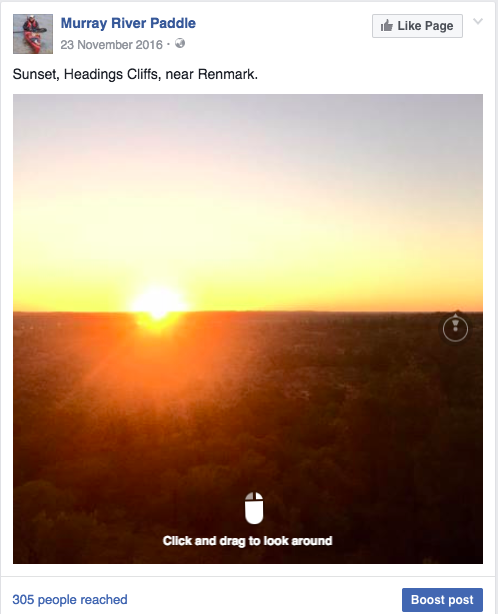
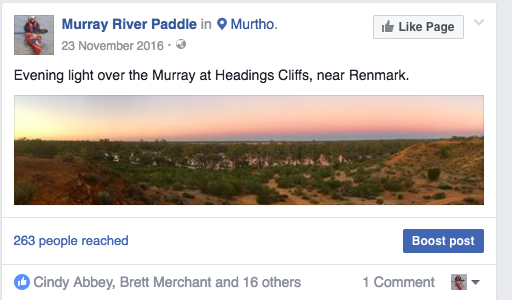
We pulled into a campsite frequented by round Australia travellers on the downstream side of Heading Cliffs, about 30km out of Renmark. Here the steep cliffs retreat inland several hundred meters, allowing a river flat to form at their base. We gathered speed and launched our kayaks up on the shore, then, finding a spot between two black box, pulled up our boats and set up camp. Endangered white breasted tree-creepers flitted around us whilst we cooked and whistling kites practised their manoeuvres on the ever changing breeze. We walked up to the top of the cliffs to see the sunset, stopping to watch some young red kangaroos on the way. From the top of the cliffs, the sun set as an orange ball. Its light bathed the valleys between us in a golden light. The birds were quiet now. There was just the light. Over the river the sky turned blue and green. The swirls caused by the current picking up some of these colours on its otherwise dark surface as it continued its journey on to the sea.

Tomorrow we make for Renmark. It will be Anna’s last day with me. Having her with me has been a real highlight. It is not often that a father and daughter have a chance to do something like this together. When your daughter lives on the other side of the world, it is even more special. For Anna, it has been a real dose of Australia. Its wilderness, its isolation, the harshness of its environment and its gentle beauty. She has brought me within 600 km of the sea. Not long to go now.