Day 49 & 50: 212km Walker's Flat 4th Dec 2016
Blanchetown Hotel - Ski Club - Expeditioners - Flood wave attenuation - Floodplain - Fisheries - Cliffs - Cockatoos - Rain - Shacks - Gorge - Travellers

Rest Day then Blanchetown to Walkers Flat
Sometimes the unexpected happens. I found myself a guest at the ski club table at the Blanchetown hotel. Rob and Sally, my neighbors at the caravan park, had invited me to join their family for dinner. Rob told me that in South Australia there has only recently been limits set on how much water can be pumped from aquifers for irrigation and that the underground streams that run through the limestone beneath the farms are beginning to run dry. No wonder with so many centre pivots and few controls. Rob and Sally are from Mt Gambier. They come to the lower Murray to ski because the river is wide and it's not crowded, and because the ski club has great programs for kids.
Earlier in the afternoon, I met Warren, a Murray Expeditioner from 1991 - before there were mobile phones. He would find a payphone in towns he passed through to let his wife know all was ok. He couldn't look up the weather, or use google maps... Although it was not all that long ago, much has changed.
Warren gave me a hand to carry things down to the boat and at 8:30 I was off, ready for the Lock opening time. Barry, the lock master saw me coming and had the gates open by the time I was there. He said the peak was predicted to arrive in a few weeks, but that by the time the water reached Blanchetown only about 80,000 megalitres a day was expected, the rest being used by irrigation pumps, or absorbed into the flood plains. Barry was upset about the Murray cod deaths from blackwater upstream and asked why more water could not be released from the Darling (Menindee Lake) to provide a safe place for the fish to shelter in until the black water passes. We talked about investing in the health of the river. Barry told me that there is only one fisheries officer for all of the South Australian rivers. That person is expected to patrol the whole of the South Australian Murray, the Onkaparinga and the Torrens rivers.
The weather was calm when I left the caravan park, but by the time I left the lock chamber it had begun to drizzle. The drizzle stayed with me. By the afternoon, it had turned into a soaking rain. I pulled out my wet weather gear and continued on, toasty warm, despite everything around me being so wet. I had looked forward to the predicted 38 deg C and strong Northerly winds. It would have been the first time I would have had a day of tailwinds in the whole trip. Neither happened. The overcast skies kept the temperature down and the wind continued gusting from the southwest - straight into my face. Waves crashed over the front deck slamming into my water bottles, my second line of defence.
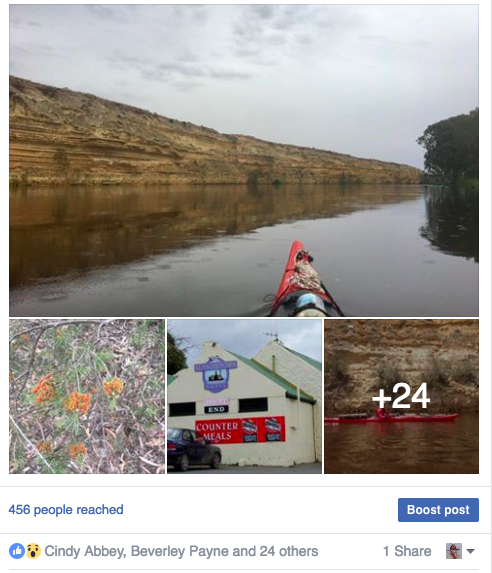
The cliffs downstream from Blanchetown are the biggest on the Murray and where the river runs alongside them, they have vertical faces. Big Bend is made up of two curves, one curving west and one curving east. Each runs for about 5 kilometers and both were filled with cockatoos. The cockatoos occupied small hollows and when I approached flew noisily into the air. At first I thought that they were after minerals from the cliff face, but on looking more closely, I saw that they were in pairs. They appear to be nesting in the rock rather than tree hollows. The cliffs do not have the thick sandstone layers that those upstream have, making them harder and more resistant to erosion.
Once the rain cleared for the last hour or so of today's eight hour paddle, the colors had a new crispness and depth. It was as though someone had hit the enhance button. When the sun broke through the clouds, it became steamy and hot. I shed my rain jacket and applied sunscreen. People began to get out into the water again. A ski boat zoomed past, followed by a traditional clinker hulled river launch. Interestingly the rear waves from the older boat went on for kilometers. I think it had something to do with the hull design.
Farms and properties along the river continued to be developed as shack areas. These holiday homes are called shacks because their original purpose was as places to fish and hunt from to help city people out during the depression years. The right to maintain a 'shack' is written in law. A few original shacks remain, little more than corrugated iron bush huts, but most shacks are a far cry in both design and purpose. Newer shacks are usually 2 story, with verandas and lounges from which to enjoy the river. Many modify the bank using terraces and retaining walls. All have removed the understory vegetation and replaced it with lawn.
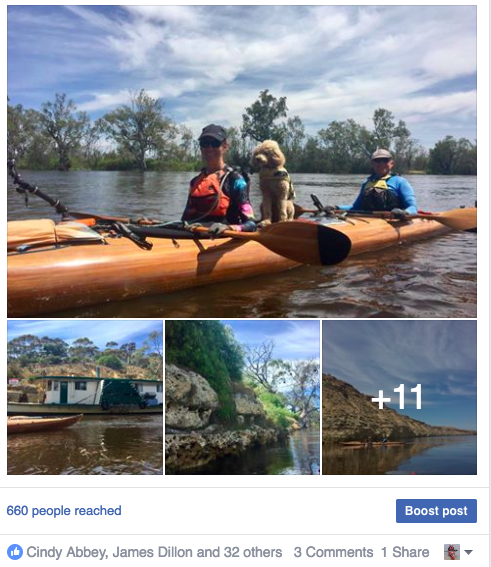
On this section of the river, the ancient Murray Gorge, through which the current Murray flows is very narrow, little more than a kilometer. Old river beds form billabongs running parallel to the river, resulting in a rich and varied habitat for both animal and plant life, all the time contrasted by the arid hills beyond. Bends run for up to 10 kilometers and the river is wide. It doesn't take much for the wind to whip up waves to test a weary paddler.
Coming into Walkers Flat I found a spot next to a German couple, Carsten and Christiana, who have been traveling the world in their expedition grade camper for 4 years. Over a few beers I told them things I thought would interest of the Murray and listened to their stories of South America, Asia, Antarctica and Australia.
Tomorrow I make for Younghusband, after making time to resupply at the Walkers Creek Shop. All the time I am getting closer to the sea. Not many more days now.